
Home DogsDog Age Calculator: How Old is Your Pup in Human Years?

Dog Age Calculator: How Old is Your Pup in Human Years?

by Vetic Editorial
Published: Updated: 9.6K views
Share

How Old Is My Dog in Human Years?

“She’s two, so that’s like… 14 in human years, right?” If you’ve said that about your dog, you’re not alone. For years, dog parents have used the 7:1 rule—multiply your dog’s age by 7 to get their human age. But modern science says aging in dogs isn’t that simple. It’s not just about counting years—it’s about how quickly a dog’s body and organs age based on size, breed, and even their DNA.

In this article, we explore the science behind dog aging, look at how small and large dogs differ, and answer the most common pet parent questions with evidence-based insights and expert commentary.


How Do Researchers Calculate Dog Age in Human Years?

Forget the old math. In 2019, a team of researchers from the University of California, San Diego found a more accurate way to translate dog years into human years using epigenetics, specifically, biological markers on the DNA that change with age in both dogs and humans.

They proposed a logarithmic formula, Human age = 16 × ln(dog’s age) + 31
(where ln = natural logarithm)
(Wang et al., 2019)

So, without going breed-specific, using the updated formula,

  • 1-year-old dog is around 31 years old in human years
  • 4-year-old dog is around 52 years old in human years
  • 10-year-old dog is around 67 years old in human years

This formula is based on Labrador Retrievers but gives a better sense of how rapidly dogs age in their early years before slowing down in middle and old age. 

Do Small and Large Dogs Age at the Same Rate?

No, they age very differently.

All dogs mature quickly in the first couple of years, but after that, size matters. Small breeds age more slowly and live longer, while large and giant breeds age faster and have shorter lifespans. This pattern has been consistently observed in large cohort studies across dog populations.

For example:

  • A 5-year-old Chihuahua may be an adult.
  • A 5-year-old Great Dane is already middle-aged.

This difference is partly due to accelerated cell growth in large dogs, which increases the risk of cellular damage, oxidative stress, and age-related diseases (Kraus et al., 2013).

Why Do Large Dogs Have Shorter Lifespans?

This question has puzzled both scientists and dog lovers.

Dr. Abhishek Choudhary explains, “Large breeds often experience rapid skeletal and muscular development in their first 12–18 months. This intense growth rate contributes to earlier wear and tear on the joints and cardiovascular system. Conditions like osteosarcoma and dilated cardiomyopathy are particularly common in breeds like Great Danes, Dobermans, and Rottweilers.”

In short, large dogs live fast, and sadly, age faster.

What’s the Average Lifespan of Dogs Based on Size?

Here’s a quick comparison, based on scientific observations:
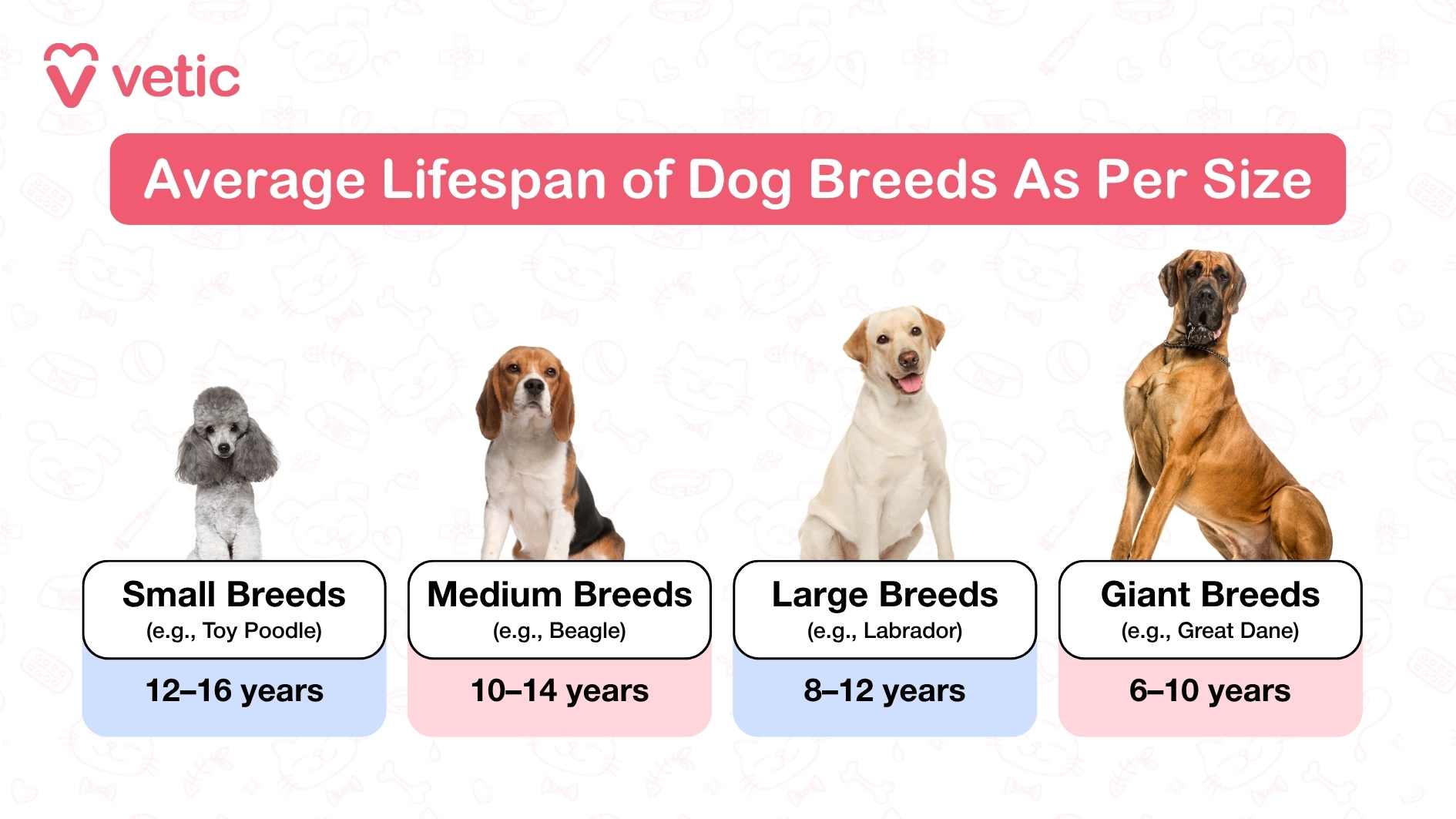
The infographic from Vetic visually categorizes dog breeds based on their size and corresponding average lifespan. It divides breeds into four distinct groups: small, medium, large, and giant, with an example breed and lifespan range for each category. Small breeds, such as the Toy Poodle, typically live between 12 to 16 years, while medium-sized breeds like the Beagle have an expected lifespan of 10 to 14 years. Large breeds, such as the Labrador Retriever, generally live 8 to 12 years, and giant breeds like the Great Dane have the shortest lifespan, averaging 6 to 10 years.

Interestingly, within these categories, genetic diversity also plays a role. For example, mixed-breed dogs tend to live about 1.2 years longer on average than purebred dogs (Creevy et al., 2016).

Do Mixed-Breed Dogs Really Live Longer?

Yes! Studies suggest that mixed-breed dogs have greater genetic variability, which reduces the chances of inheriting recessive genetic disorders common in purebred dogs due to selective breeding (Creevy et al., 2016). This is sometimes called the “hybrid vigor” effect.

Of course, care, environment, and luck still matter—but on average, mixed breeds tend to enjoy longer, healthier lives.

What About Flat-Faced Dogs Like Pugs and Bulldogs?

Today I will attach images which are a part of the blog "how old is your dog in human years" I need you to accurately describe the content of the images including the illustrations and the OCR text. Avoid giving me bullets and numbered lists - return the description in the form of complete sentences and short comprehensive paragraphs only. Understood! Attach the images, and I’ll provide detailed descriptions in structured and engaging paragraphs that accurately capture both the illustrations and the text within them. Looking forward to helping you refine your blog’s content. The infographic from Vetic visually categorizes dog breeds based on their size and corresponding average lifespan. It divides breeds into four distinct groups: small, medium, large, and giant, with an example breed and lifespan range for each category. Small breeds, such as the Toy Poodle, typically live between 12 to 16 years, while medium-sized breeds like the Beagle have an expected lifespan of 10 to 14 years. Large breeds, such as the Labrador Retriever, generally live 8 to 12 years, and giant breeds like the Great Dane have the shortest lifespan, averaging 6 to 10 years. The infographic presents this information in a structured and visually engaging format, making it a useful reference for dog owners looking to understand the longevity of different breeds based on their size. Let me know if you'd like any refinements to match your blog's tone and style! The infographic from Vetic highlights key factors that influence the lifespan of flat-faced dog breeds. It presents five major health concerns—BOAS (Brachycephalic Obstructive Airway Syndrome), overheating, chronic skin disease, gut health problems, and dental crowding—which are commonly associated with breeds like pugs and bulldogs. The layout is clean and structured, with each factor marked by a colored arrow that enhances readability. On the right side of the image, there is an illustration of a flat-faced dog, likely a pug, reinforcing the topic visually. The background features a subtle pattern composed of pet-related icons, adding a thematic touch to the design.

These brachycephalic breeds don’t necessarily have shorter lifespans due to age—but their quality of life is often affected earlier due to chronic conditions. These include:

  • Brachycephalic Obstructive Airway Syndrome (BOAS)
  • Overheating
  • Dental crowding

Dr. Abhishek Choudhary adds:
“We often see young brachycephalic dogs requiring surgical interventions or lifestyle adjustments by age 3 or 4. While they may live to 10 or 12 years, their day-to-day functioning can start to decline earlier than expected.”

It’s important to monitor such breeds for respiratory, dental, and weight-related issues starting from a young age.

Does Spaying or Neutering Impact Longevity?

Yes, and the timing matters.

Dogs that are spayed or neutered tend to live longer. The procedure lowers the risk of certain cancers, infections, and behavioral issues. However, in large breeds, spaying or neutering too early (before bone growth plates close) may increase the risk of joint problems and some cancers (Kraus et al., 2013).

A balanced approach—guided by your veterinarian—is ideal, especially for breeds like Golden Retrievers, German Shepherds, and Rottweilers.

Do Working Dogs Age Differently Than Companion Breeds?

Yes. Dogs bred for work—like herding, guarding, or sporting—have higher physical demands and often show signs of aging earlier than toy or companion breeds.

This is partly due to their metabolic rate, muscle activity, and genetic predisposition to joint wear and tear. For instance, Golden Retrievers, German Shepherds and Belgian Malinois often start showing joint stiffness or behavioral slowdown by age 6 or 7.

That’s not to say they can’t live long, healthy lives—but routine vet visits and preventive care become essential by midlife.

What Other Factors Influence How Fast Dogs Age?
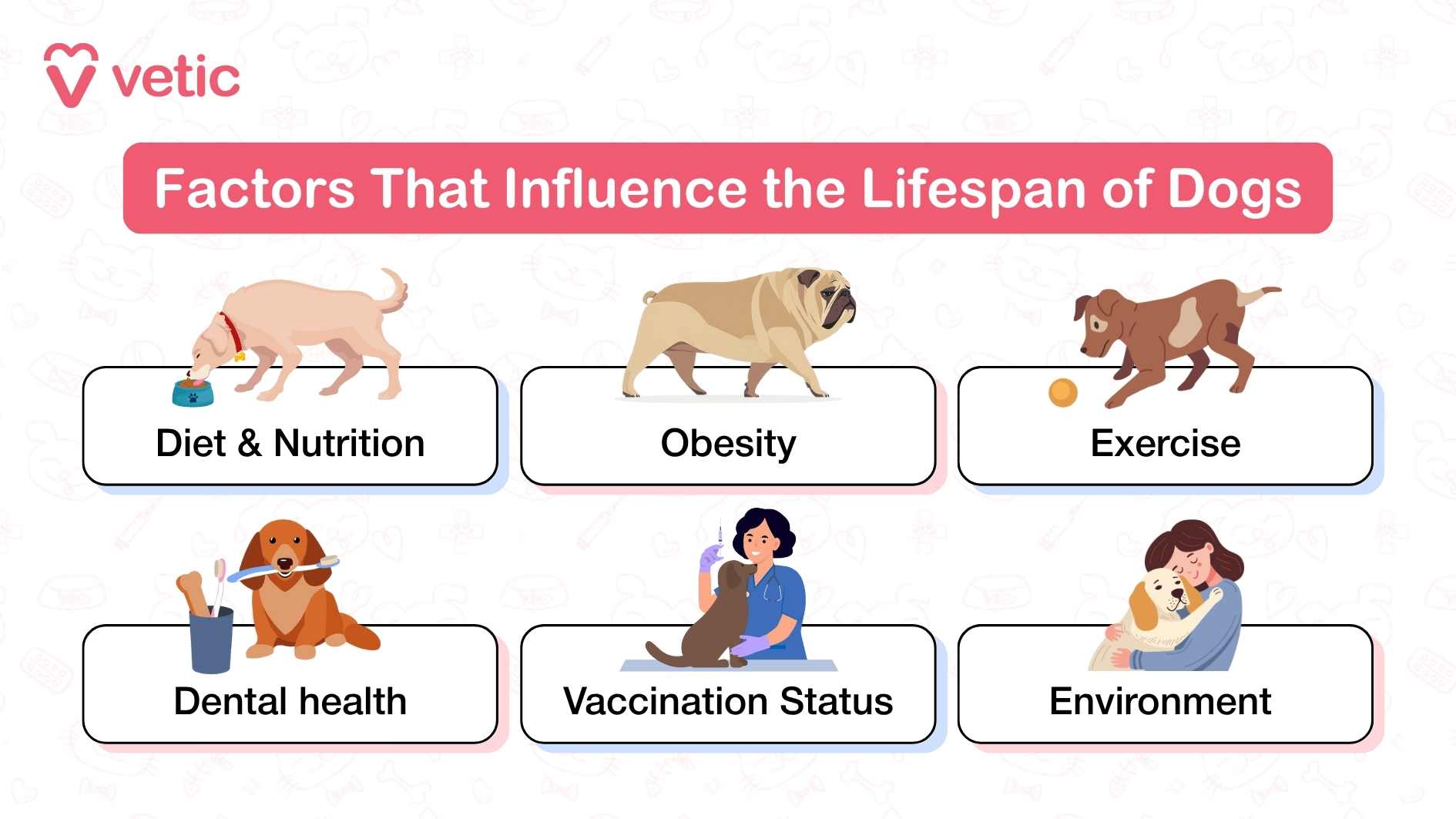
This infographic from Vetic highlights six key factors that influence a dog's lifespan, presenting each factor through simple and engaging illustrations. It emphasizes the importance of diet and nutrition, depicting a dog eating from a bowl to represent how balanced meals contribute to a healthier life. Obesity is shown through an overweight dog, reinforcing that maintaining an appropriate weight is crucial for longevity. Exercise is portrayed by a dog playing with a ball, illustrating how physical activity keeps dogs fit and improves their well-being. Dental health is symbolized by a dog holding a toothbrush, reflecting the significance of oral hygiene in preventing diseases that could impact overall health. The infographic also underscores the role of vaccination status, with an image of a veterinarian administering a vaccine to a dog, demonstrating that preventive healthcare is vital in prolonging life. Finally, the environment is represented by a person affectionately hugging a dog, conveying the importance of emotional well-being, security, and a nurturing home.

In addition to breed and size, aging is influenced by:

  • Diet & Nutrition: Poor-quality food can speed up organ degeneration.
  • Obesity: Dogs who are overweight are more prone to diabetes, arthritis, and shortened lifespans.
  • Exercise: Lack of activity can age both body and mind.
  • Dental care: Gum disease can lead to heart and kidney issues.
  • Environment: Dogs exposed to second-hand smoke, poor air quality, or stress may age faster.

So… How Old Is My Dog Really?

To get a clearer picture of your dog’s age in human terms:

  • Use scientific charts based on breed and size.
  • Consider health, weight, and medical history.
  • Watch for signs of aging: changes in sleep, energy, appetite, mobility.

Because at the end of the day, your dog’s health speaks louder than any formula.

Final Thoughts

Knowing how your dog ages helps you plan better, care smarter, and love deeper. They may not live as long as we’d like—but with thoughtful care, your dog can live those years happily and healthily.

Forget 7 dog years to one human year. Your dog’s real age is a story written by their DNA, breed, size, and your care. So give them the best possible chapter every single day.


References (APA Style)

Creevy, K. E., Austad, S. N., Hoffman, J. M., & Promislow, D. E. L. (2016). The Dog Aging Project: Translational geroscience in companion animals. Mammalian Genome, 27(7-8), 279–288. https://doi.org/10.1007/s00335-016-9638-7

Kraus, C., Pavard, S., & Promislow, D. E. L. (2013). The size–life span trade-off decomposed: Why large dogs die young. The American Naturalist, 181(4), 492–505. https://doi.org/10.1086/669665

Wang, T., Tsui, B., Kreisberg, J. F., Robertson, N. A., Gross, A. M., Yu, M. K., ... & Ideker, T. (2019). Quantitative translation of dog-to-human aging by conserved remodeling of epigenetic networks. Cell Systems, 9(3), 272–284.e6. https://doi.org/10.1016/j.cels.2019.08.002


Want to know more about pets?

Popular Searches

Consultation for Dog Near Me | About Us | Grooming for Dog Near Me | Vaccination for Dog Near Me | Surgery for Dog Near Me | Emergency Care for Dog Near Me | Consultation for Cat Near Me | Grooming for Cat Near Me | Vaccination for Cat Near Me | Surgery for Cat Near Me | Emergency Care for Cat Near Me | Pet Clinic in Gurgaon | Pet Clinic in Delhi | Pet Clinic in Hyderabad | Pet Clinic in Mumbai | Pet Clinic in Chennai | Pet Clinic in Noida | Pet Clinic in Ghaziabad | Pet Clinic in Bangalore | Pet Clinic in Pune | Pet Clinic in Faridabad | Pet Clinic in Kolkata | Pet Consultation in Gurgaon | Pet Consultation in Bangalore | Pet Consultation in Chennai | Pet Consultation in Delhi | Pet Consultation in Hyderabad | Pet Consultation in Mumbai | Pet Consultation in Ghaziabad | Pet Consultation in Pune | Pet Consultation in Faridabad | Pet Consultation in Noida | Pet Consultation in Kolkata | Pet Grooming in Bangalore | Pet Diagnostics in Bangalore | Pet Surgery in Delhi | Pet Emergency Care in Mumbai | Pet Clinic in Golf Course Road, Gurgaon | Pet Clinic in Sector 45, Gurgaon | Pet Clinic in Sohna Road, Gurgaon | Pet Clinic in Galleria Market, Gurgaon | Pet Clinic in Sector 57, Gurgaon | Pet Clinic in Sector 82, Gurgaon | Pet Clinic in Greater Kailash, Delhi | Pet Clinic in Pitampura, Delhi | Pet Clinic in Sector 11, Delhi | Pet Clinic in Defence Colony, Delhi | Pet Clinic in Malviya Nagar, Delhi | Pet Clinic in Anand Vihar, Delhi | Pet Clinic in Vasant Kunj, Delhi | Pet Clinic in Hitec City, Hyderabad | Pet Clinic in Secunderabad, Hyderabad | Pet Clinic in Manikonda, Hyderabad | Pet Clinic in Banjara Hills, Hyderabad | Pet Clinic in Kukatpally, Hyderabad | Pet Clinic in Kandivali, Mumbai | Pet Clinic in Thane West, Mumbai | Pet Clinic in Andheri West, Mumbai | Pet Clinic in Chembur, Mumbai | Pet Clinic in Sanpada, Mumbai | Pet Clinic in Mira Road, Mumbai | Pet Clinic in Borivali, Mumbai | Pet Clinic in Powai, Mumbai | Pet Clinic in Banerghatta, Bangalore | Pet Clinic in HSR Layout, Bangalore | Pet Clinic in Domlur, Bangalore | Pet Clinic in Kalyan Nagar, Bangalore | Pet Clinic in Whitefield, Bangalore | Pet Clinic in Sadashiva Nagar, Bangalore | Pet Clinic in Nagarbhavi, Bangalore | Pet Clinic in Electronic City, Bangalore | Pet Clinic in Banashankari, Bangalore | Pet Clinic in Yelahanka, Bangalore | Pet Clinic in Sarjapur Road, Bangalore | Pet Clinic in Koramangala, Bangalore | Pet Clinic in Aundh, Pune | Pet Clinic in Kalyani Nagar, Pune | Pet Clinic in NIBM, Pune | Pet Clinic in Wakad, Pune | Pet Clinic in Sector 20, Noida | Pet Clinic in Sector 49, Noida | Pet Clinic in Indirapuram, Ghaziabad | Pet Clinic in Sector 14, Faridabad | Pet Clinic in Salt Lake, Kolkata | Pet Clinic in Anna Nagar, Chennai | Veterinary Hospital Near Me | Pet Clinic Near Me | Vet Near Me | Pet Grooming Clinic Near Me | Pet Cancer Treatment Near Me | Pet Grooming in Chennai | Pet Grooming in Delhi | Pet Grooming in Gurgaon | Pet Grooming in Hyderabad | Pet Grooming in Mumbai | Pet Grooming in Ghaziabad | Pet Grooming in Pune | Pet Grooming in Faridabad | Pet Grooming in Noida | Pet Grooming in Kolkata | Pet Diagnostics in Chennai | Pet Diagnostics in Delhi | Pet Diagnostics in Gurgaon | Pet Diagnostics in Hyderabad | Pet Diagnostics in Mumbai | Pet Diagnostics in Ghaziabad | Pet Diagnostics in Pune | Pet Diagnostics in Faridabad | Pet Diagnostics in Noida | Pet Diagnostics in Kolkata | Pet Surgery in Bangalore | Pet Surgery in Chennai | Pet Surgery in Gurgaon | Pet Surgery in Hyderabad | Pet Surgery in Mumbai | Pet Surgery in Ghaziabad | Pet Surgery in Pune | Pet Surgery in Faridabad | Pet Surgery in Noida | Pet Surgery in Kolkata | Pet Emergency Care in Bangalore | Pet Emergency Care in Chennai | Pet Emergency Care in Gurgaon | Pet Emergency Care in Hyderabad | Pet Emergency Care in Ghaziabad | Pet Emergency Care in Pune | Pet Emergency Care in Faridabad | Pet Emergency Care in Noida | Pet Emergency Care in Kolkata

    Consult A Vet

    Book An Appointment


    image
    Call A Vet
    ×

      Consult A Vet

      Book An Appointment