Indoor plants make a home feel fresh and welcoming, but for cat parents, greenery also raises an important question: Is this plant safe for my cat? Cats are naturally curious and may chew leaves, dig in soil, or brush against plants. Some common houseplants can cause vomiting, mouth irritation, or serious poisoning.
Choosing safe indoor plants for your cats lets you enjoy plants without putting your pet at risk. This guide explains what makes plants dangerous, why pet-safe plants matter, and which house plants work well in Indian homes with cats.
What Makes An Indoor Plant Dangerous For Your Cat?
A plant becomes dangerous to cats when it contains toxic compounds that irritate tissues or interfere with normal body functions. Cats are especially vulnerable because they groom themselves and may ingest plant toxins from their paws or fur, even after only brief contact with a leaf.
Some plants contain calcium oxalate crystals that cause immediate burning and swelling in the mouth and throat. Others contain chemicals that can affect vital organs such as the heart, kidneys, or nervous system once absorbed into the body.
In cats, even small amounts can trigger symptoms such as:
- Vomiting or diarrhoea
- Excessive drooling and pawing at the mouth
- Lethargy or weakness
- Difficulty swallowing or breathing
Because cats have a limited ability to break down certain toxins, exposure can be more serious for them than for other pets. This is why choosing house plants that are safe for cats is far safer than assuming a plant is harmless based on appearance alone.
Discuss how indoor plants affect your cat with a cat consultation.
Why Choose Pet-Safe Indoor Plants?
Choosing house plants that are not toxic to cats helps protect your cat while still allowing you to enjoy indoor greenery. Cats naturally explore their environment by sniffing, rubbing against, and sometimes chewing plants. Even if they do not intend to eat them, they may swallow plant material while grooming their paws or fur afterward.
Toxic plants can quickly turn this normal behaviour into a medical emergency, whereas non-toxic houseplants allow safe interaction without serious health risks.
Benefits of choosing such non-toxic plants include:
- A much lower risk of accidental poisoning
- Reduced chances of vomiting, mouth irritation, or organ damage
- Greater peace of mind for pet parents
- A safer indoor environment for curious and playful cats
- Visual and sensory enrichment without compromising health
Selecting cat-safe plants supports both your home’s aesthetics and your cat’s well-being.
Learn how pet-safe plants help your cat’s health with our cat diagnostics.
Top Pet-Friendly Indoor Plants for Indian homes
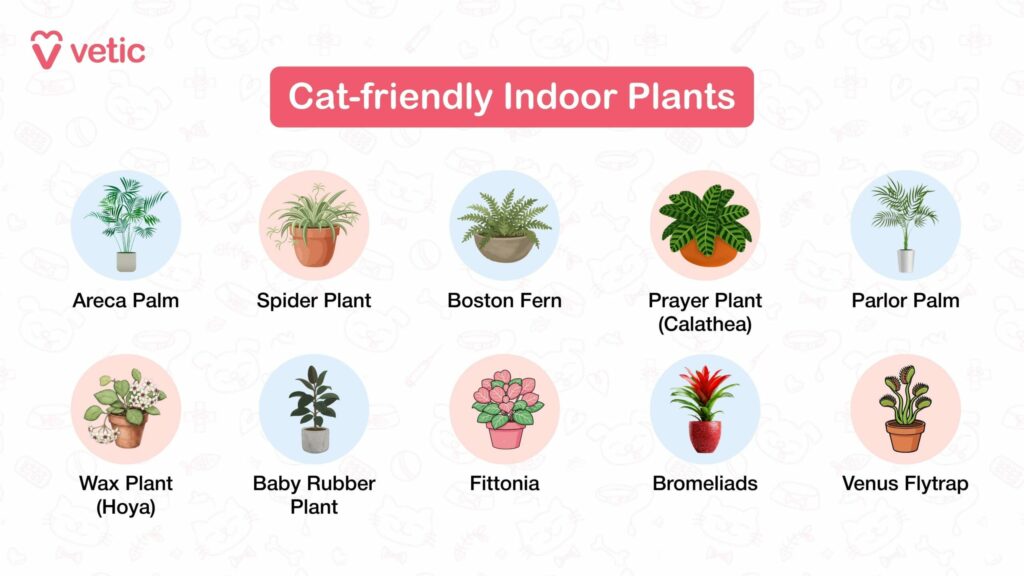
The following plants are commonly available in India and are considered non-toxic to cats. Each plant is discussed after the list given, along with its origin and basic care needs.
- Areca Palm
- Spider Plant
- Boston Fern
- Prayer Plant (Calathea)
- Parlor Palm
- Wax Plant (Hoya)
- Baby Rubber Plant
- Fittonia
- Bromeliads
- Venus Flytrap
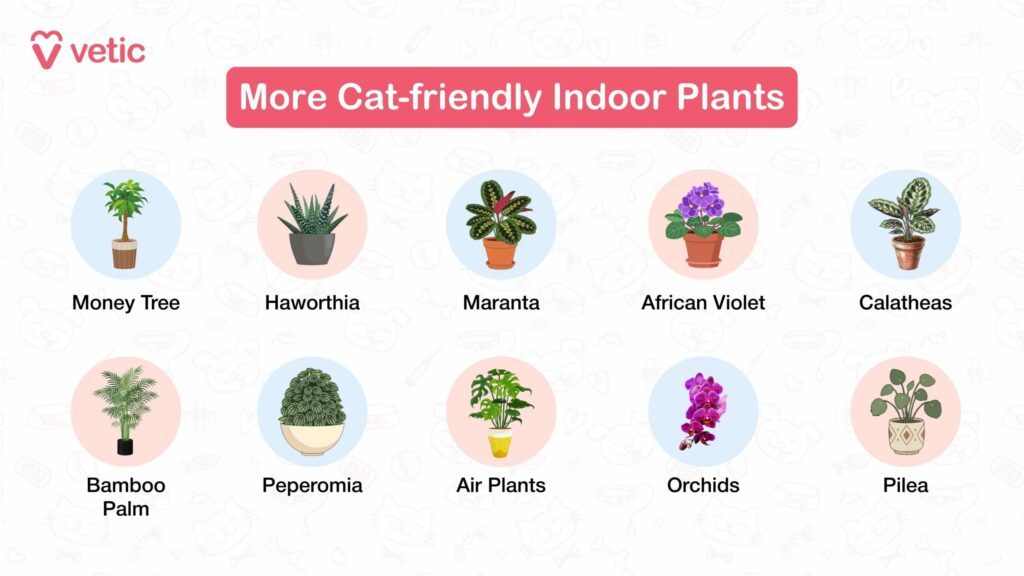
- Money Tree
- Haworthia
- Maranta
- African Violet
- Calatheas
- Bamboo Palm
- Peperomia
- Air Plants
- Orchids
- Pilea
1. Areca Palm
(Areca Palm / Dypsis lutescens – commonly called “Areca Palm” or “Golden Cane Palm” in India)
Areca palm is non-toxic to cats and safe for the indoors. It does not cause mouth irritation, vomiting, or systemic toxicity if a cat rubs against it or chews the leaves. Its soft fronds make it suitable for areas where cats move around freely.
The Areca palm is native to Madagascar, where it grows in warm tropical climates. This natural habitat makes it suitable for Indian indoor conditions.
Areca Palm Care:
Grows best in bright, indirect light. Water when the topsoil feels slightly dry. Avoid waterlogged soil. Prefers warm temperatures and good airflow.
2. Spider Plant
(Spider Plant / Chlorophytum comosum – commonly called “Ribbon Plant” or “Airplane Plant” in India)
Spider plants are non-toxic and safe for cats. Cats may chew the long leaves, but ingestion does not cause poisoning or organ damage. While non-toxic, excessive chewing may cause mild stomach upset. It is often chosen for homes with curious or playful cats.
The spider plant is native to southern Africa and grows well in varied indoor conditions.
Spider Plant Care:
Grows best in bright, indirect light. Water the soil surface when it dries. Avoid letting the plant sit in soggy soil.
Suggested Read: What Fruits and Vegetables Can Cats Safely Eat?
3. Boston Fern
(Boston Fern / Nephrolepis exaltata – commonly called “Sword Fern” or “Boston Fern” in India)
Boston fern is non-toxic to cats and safe if brushed against or lightly chewed. It does not contain toxic compounds, though large amounts may cause mild stomach upset due to high fibre content.
Boston fern is native to tropical and subtropical forests and naturally grows in humid, shaded environments.
Boston Fern Care:
Grows best in bright, indirect light with high humidity. Keep soil evenly moist and mist regularly in dry indoor air.
4. Prayer Plant (Calathea)
(Prayer Plant / Calathea species – commonly called “Prayer Plant” or “Peacock Plant” in India)
Prayer plants are non-toxic to cats and safe for homes. They do not cause oral irritation or systemic toxicity if chewed. Their leaf movement makes them interesting without posing a risk to pets.
Prayer plants are native to tropical South America and grow under forest canopies.
Prayer Plant Care:
Grows best in warm indoor temperatures with medium to bright indirect light. Keep soil lightly moist and maintain humidity.
5. Parlor Palm
(Parlor Palm / Chamaedorea elegans – commonly called “Parlor Palm” or “Table Palm” in India)
Parlor palm is non-toxic to cats and safe for homes. It does not cause mouth irritation, vomiting, or systemic toxicity if a cat rubs against or chews the leaves. Its slow growth and compact size make it suitable for small apartments and low-light areas.
Parlor palm is native to Central America, where it grows under forest canopies. This natural habitat makes it tolerant of low light and indoor environments.
Parlor Palm Care:
Grows best in low to bright indirect light. Water when the topsoil feels dry. Avoid soggy soil. Prefers stable indoor temperatures and moderate humidity.
6. Wax Plant (Hoya)
(Wax Plant / Hoya species – commonly called “Wax Plant” in India)
Hoya is non-toxic to cats and safe for indoors. It does not cause mouth irritation or digestive toxicity if chewed. Its thick leaves are generally less appealing for chewing.
Hoyas are native to Asia and Africa and grow as climbing plants in warm climates.
Hoya Care:
Grows best in bright indirect light. Allow the soil to dry between watering. Some direct sunlight supports flowering.
7. Baby Rubber Plant
(Baby Rubber Plant / Peperomia obtusifolia – commonly called “Baby Rubber Plant” in India)
Baby rubber plants are non-toxic to cats and safe for homes. It must not be confused with the rubber plant (Ficus), which is toxic. It does not cause oral burns or organ toxicity if chewed.
It is native to tropical Central and South America.
Baby Rubber Plant Care:
Grows best in bright indirect light. Water when the top layer of soil dries slightly. Avoid waterlogging.
Suggested Read: Is Your Cat in Heat
8. Fittonia
(Fittonia / Fittonia albivenis – commonly called “Nerve Plant” in India)
Fittonia is non-toxic to cats and safe for homes. It does not cause mouth irritation or systemic toxicity if brushed against or lightly chewed.
Fittonia is native to Peru and grows as ground cover in tropical rainforests.
Fittonia Care:
Grows best in bright indirect light with moist soil. Wilts when thirsty and recovers after watering. Benefits from regular misting.
9. Bromeliads
(Bromeliad family – commonly sold as “Bromeliad” in India)
Bromeliads are non-toxic to cats and safe for indoors. They do not contain calcium oxalates or cardiac toxins and do not cause oral irritation.
They are native to tropical forests and often grow attached to trees.
Bromeliad Care:
Grows best in low to bright indirect light. Fill the central cup with water and maintain humidity. Avoid soaking roots.
10. Venus Flytrap
(Venus Flytrap / Dionaea muscipula – commonly called “Insectivorous Plant” in India)
Venus flytrap is non-toxic to cats and safe for indoors. Chewing does not cause poisoning, but rough handling may damage the plant. Repeated chewing may cause damage to the cats’ gums but not toxicity.
It is native to the wet bogs of North and South Carolina in the United States.
Venus Fly Trap Care:
Needs bright indirect sunlight. Use distilled or rainwater and keep the soil consistently moist.
11. Money Tree
(Money Tree / Pachira aquatica – commonly called “Money Tree” in India)
Money trees are non-toxic to cats and safe for homes. It should not be confused with money plants (pothos), which are toxic.
It is native to Central and South America.
Money Tree Care:
Grows best in bright indirect light. Water once or twice a week, depending on the temperature. Avoid waterlogged soil.
12. Haworthia
(Haworthia – commonly called “Zebra Plant” or “Mini Aloe” in India)
Haworthia is non-toxic to cats and safe for homes. It does not contain anthraquinones like those found in aloe vera and does not cause digestive toxicity.
It is native to South Africa.
Haworthia Care:
Grows best in bright indirect to direct light. Water every 2–3 weeks after the soil has dried completely.
Suggested Read: What is Grain-Free Cat Food?
13. Maranta
(Maranta / Prayer Plant – commonly called “Prayer Plant” in India)
Maranta is also known as prayer plants in India. They are non-toxic to cats and safe for indoors. It does not cause oral burns or organ damage if chewed.
It is native to Central and South America.
Maranta Care:
Grows best in medium to bright indirect light. Allow the soil to dry halfway between watering. Use filtered water if possible.
14. African Violet
(African Violet / Saintpaulia – commonly called “African Violet” in India)
African violet is non-toxic to cats and safe for indoors. It does not cause mouth irritation or poisoning if chewed.
It is native to eastern Africa.
African Violet Care:
Grows best in bright indirect light. Water from the base to avoid wet leaves. Avoid direct sunlight.
15. Calatheas
(Calathea species – commonly called “Peacock Plant” in India)
Calatheas are non-toxic to cats and safe for homes. They must not be confused with calla lilies, which are toxic.
They are native to tropical Brazil and forested regions.
Calathea Care:
Grows best in medium to bright indirect light. Keep soil lightly moist and humidity high.
16. Bamboo Palm
(Chamaedorea seifrizii – commonly called “Bamboo Palm” in India)
Bamboo palm is non-toxic to cats and safe for indoor homes. It does not cause poisoning if chewed.
It is native to Central America.
Bamboo Palm Care:
Grows best in bright, indirect light. Water when the top layer of soil feels dry. Avoid overwatering and ensure good drainage.
17. Peperomia
(Peperomia – commonly called “Radiator Plant” in India)
Peperomia is non-toxic to cats and safe for indoors. It does not cause digestive or oral toxicity if chewed.
It is native to South America and the Caribbean.
Peperomia Care:
Grows best in bright indirect light. Water weekly or bi-weekly. Requires minimal maintenance.
18. Air Plants
(Air Plants / Tillandsia – commonly called “Air Plant” in India)
Air plants are non-toxic to cats and safe for indoors. They do not contain plant toxins and are safe if licked.
They are native to Central and South America.
Air Plant Care:
Needs bright indirect light and misting or soaking every few days. Do not allow it to dry completely.
19. Orchids
(Orchidaceae family – commonly called “Orchid” in India)
Orchids are non-toxic to cats and safe for homes. They do not cause oral irritation or organ damage.
They naturally grow attached to trees in tropical forests.
Orchid Care:
Needs bright indirect light and porous growing medium. Water when the medium dries.
20. Pilea
(Pilea peperomioides – commonly called “Chinese Money Plant” in India)
Pilea is non-toxic to cats and safe for indoors. It does not cause poisoning if chewed.
It is native to China.
Pilea Care:
Grows best in indirect light. Water once weekly or when the soil feels dry.
Other Safe Additions
Other house plants that are not toxic to cats include:
- Cast iron plant
- Friendship plant
- Ponytail palm
- Swedish ivy
These allow variety while maintaining safety.
Plants to Avoid (Toxic For Pets)
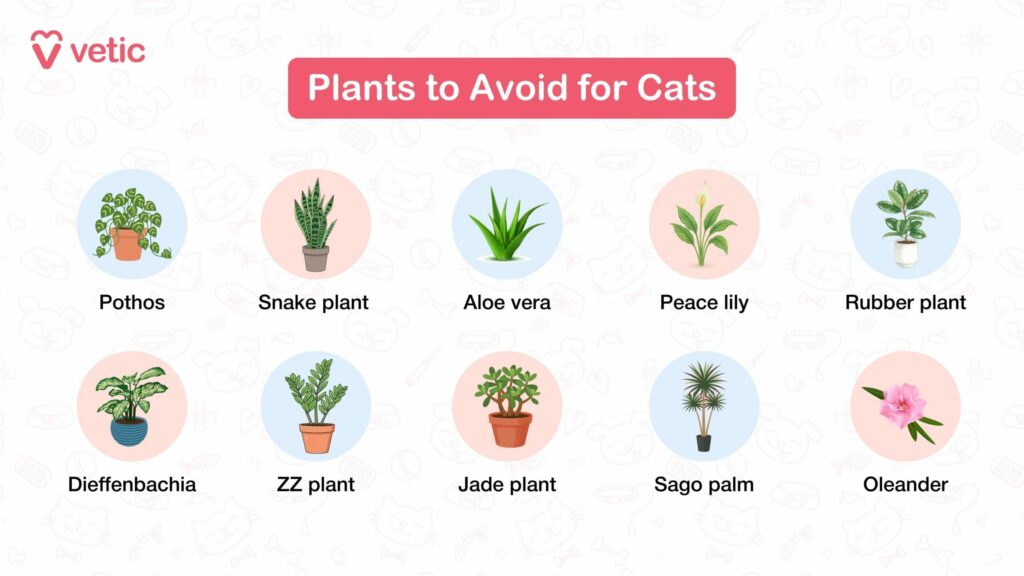
Common Indian houseplants that should be avoided in homes with pets:
- Money plant (pothos)
- Snake plant
- Aloe vera
- Peace lily
- Rubber plant
- Dieffenbachia
- ZZ plant
- Jade plant
- Sago palm
- Oleander
Tips for Gardening With Pets
- Keep plants out of reach
- Use hanging planters or shelves
- Remove fallen leaves
- Cover the soil with stones
- Provide cat grass
- Supervise new plants
Key Takeaways
- Many common plants are toxic to cats
- Cats explore by chewing, increasing the risk
- Safe indoor plants for cats allow greenery without danger
- Always verify plant safety before buying
- Toxic plants should be removed
- Placement and supervision are essential
FAQs
What are the best pet-safe indoor plants?
Spider plants, areca palms, calatheas, Boston ferns, and peperomias are among the best houseplants safe for cats because they are non-toxic, easy to maintain, and commonly available in Indian nurseries.
Are money plants safe for cats and dogs?
No, money plant (pothos) is toxic to both cats and dogs and can cause mouth irritation, vomiting, and difficulty swallowing if chewed, so it should be avoided in homes with pets.
Which indoor plants are toxic to pets and should be avoided?
Snake plants, aloe vera, peace lilies, rubber plants, pothos, and ZZ plants are toxic to pets and can cause digestive upset or mouth irritation, so they should not be kept where pets can reach them.
How do I keep pets from chewing my indoor plants?
Place plants on high shelves or in hanging pots, remove fallen leaves, and offer cat grass or toys as alternatives to chewing to help redirect your pet’s curiosity toward safer activities.
Do pet-safe indoor plants also purify air?
Some pet-safe plants mildly improve air quality, but their effect is limited; good ventilation and cleanliness remain more effective for maintaining healthy indoor air than relying on plants alone.
References:
American Society for the Prevention of Cruelty to Animals. (2024). Toxic and non-toxic plants for cats. https://www.aspca.org
International Cat Care. (2023). Houseplants and cats. https://icatcare.org
Merck Veterinary Manual. (2023). Plant toxicities in cats. https://www.merckvetmanual.com
Royal Horticultural Society. (2022). Plants are safe for pets. https://www.rhs.org.uk