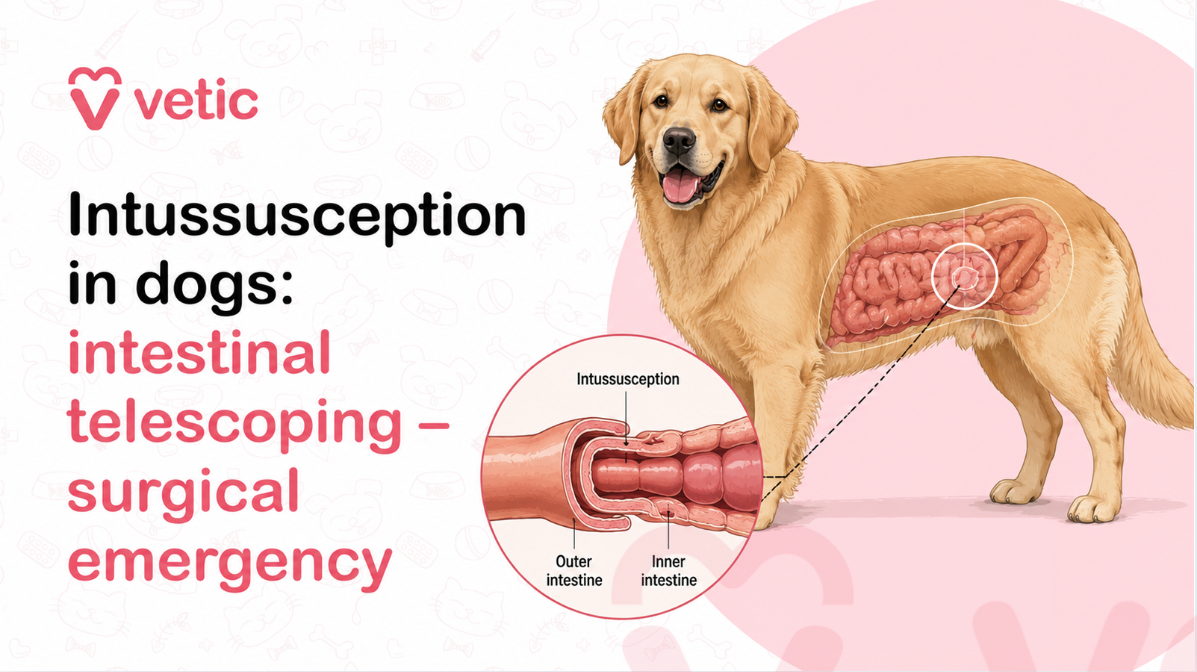
If your dog suddenly develops severe vomiting, bloody diarrhoea, and abdominal pain all at the same time, intussusception must be ruled out immediately. This condition can go from onset to life-threatening in a matter of hours.
Intussusception in dogs is one of the most time-critical abdominal emergencies in veterinary medicine. The faster it is identified and treated, the better the outcome. This article explains what it is, what causes it, how it is treated, and most importantly when to act.
What Is Intussusception in Dogs?
Intussusception occurs when one segment of the intestine telescopes or slides into the adjacent segment much like how a collapsible telescope folds into itself.
The inner segment (called the intussusceptum) gets trapped inside the outer segment (the intussuscipiens). This causes a mechanical obstruction that blocks the normal passage of food, fluid, and gas through the gut.
As the condition progresses, blood supply to the trapped segment gets cut off. Without blood flow, intestinal tissue begins to die, a process called ischaemic necrosis. This is why intussusception moves from serious to fatal so quickly.
In Plain Terms: Think of it like a sock that folds in on itself. The folded-in part gets trapped, swells, loses blood supply, and necrotises unless surgically corrected.
Intussusception most commonly occurs at the junction between the small intestine and the large intestine in an area called the ileocolic junction. However, it can occur anywhere along the gastrointestinal tract.
Why Intussusception in Dogs Is a Medical Emergency
The word emergency is not used lightly here. Intussusception is dangerous for several reasons that compound each other rapidly:
- Complete intestinal obstruction: The gut shuts down. Nothing food, water, or gas can pass through.
- Tissue death: The trapped intestinal segment loses blood supply and begins to die within hours.
- Bacterial leakage: As the intestinal wall dies, its barrier function breaks down. Gut bacteria can leak into the abdominal cavity, causing peritonitis, a severe, life-threatening infection.
- Systemic shock: Toxins from dying tissue and bacteria enter the bloodstream, leading to cardiovascular collapse.
- Dehydration and electrolyte imbalance: Persistent vomiting and inability to absorb fluids cause rapid deterioration.
Without surgical intervention, most dogs with intussusception will not survive. And the longer surgery is delayed, the greater the extent of intestinal damage which directly affects both the complexity of surgery and the outcome.
What Causes Intussusception in Dogs?
Intussusception is not a random event. In most cases, there is an underlying cause that disrupts normal intestinal motility: the coordinated wave-like contractions (peristalsis) that move food through the gut.
When one segment of intestine contracts abnormally or more forcefully than the adjacent segment, it can push itself inside the neighbouring segment.
Common underlying causes include:
Gastrointestinal Infections
- Parvoviral enteritis one of the most common triggers, particularly in young dogs
- Other viral infections including distemper and coronavirus
- Bacterial infections such as Salmonella and Campylobacter
- Intestinal parasites roundworms, hookworms, whipworms, and Giardia
Intestinal Masses and Structural Abnormalities
- Intestinal polyps or benign tumours
- Intestinal adenocarcinoma or lymphoma particularly in older dogs
- Intramural masses or adhesions from prior surgery
Other Causes
- Foreign body ingestion bones, toys, or other objects that disrupt normal motility
- Sudden dietary changes causing abnormal gut contractions
- Post-surgical changes in intestinal function
- Intussusception can also occur at the surgical anastomosis site after a previous intestinal procedure
Vet Note: In some cases, especially in young puppies, no underlying cause is identified. These are termed idiopathic intussusceptions. However, a full investigation is always warranted.
Which Dogs Are at Higher Risk of Canine Intussusception?
Intussusception can affect any dog, but certain groups are at notably higher risk.
| Age | Most common in dogs under 1 year of age. Puppies are significantly over-represented. |
| Breed | German Shepherds, Rottweilers, and Labrador Retrievers appear more frequently in case reports, though any breed can be affected. |
| Recent infection | Dogs recovering from parvovirus, intestinal parasites, or other GI infections. |
| Post-surgical | Dogs that have had prior intestinal surgery are at increased risk of recurrence at the surgical site. |
| Nutritional status | Malnourished or heavily parasitised puppies have weakened gut motility and are more vulnerable. |
Early Signs of Intussusception in Dogs
The early signs of intussusception in dogs can be subtle and easy to miss especially in a puppy who is otherwise active. They can also mimic simpler gastrointestinal problems, which is why vigilance matters.
Watch for:
- Vomiting initially may be intermittent, but tends to escalate
- Diarrhoea may contain mucus in early stages
- Loss of appetite or reluctance to eat
- Lethargy and general dullness
- Mild abdominal discomfort your dog may seem restless or reluctant to lie down
- Excessive drooling or lip-licking (signs of nausea)
- Straining to defecate with little or nothing produced
Important: Do not wait for these signs to escalate. If vomiting and diarrhoea persist for more than a few hours in a puppy, or if your dog also seems lethargic and in pain, seek veterinary attention immediately.
Severe Symptoms of Intussusception in Dogs
As the condition progresses and the intestinal obstruction worsens, symptoms become significantly more alarming. By the time these signs appear, tissue damage is often already occurring.
- Bloody diarrhoea: Often described as “red-currant jelly” in texture, a hallmark sign of intussusception.
- Projectile or unrelenting vomiting: Often bilious (yellow-green), may occur even when nothing has been eaten.
- Severe abdominal pain: Pronounced guarding of the belly, hunched posture, crying when touched.
- Abdominal bloating: Visible distension of the abdomen.
- Palpable abdominal mass: In some cases, the telescoped segment can be felt as a firm, sausage-shaped mass in the abdomen.
- Weakness and collapse: Signs of shock pale gums, rapid heart rate, cold extremities, inability to stand.
- Complete cessation of defecation: A dog that has stopped passing stool entirely has a complete obstruction until proven otherwise.
Emergency Alert: Pale or white gums, collapse, and unresponsiveness are signs of shock. This is a veterinary emergency. Do not wait. Go to an emergency clinic immediately.
How Intussusception Affects the Intestines
Understanding what happens inside the gut helps explain why time is so critical in these cases.
When the intussusceptum (the inner telescoped segment) gets trapped inside the intussuscipiens (the outer segment), several things happen simultaneously:
- The mesentery the tissue that anchors the intestine and carries its blood supply gets pulled into the telescoped segment and compressed.
- Venous drainage from the trapped segment is blocked first, causing the tissue to become engorged with blood and swell.
- As swelling increases, arterial blood flow is also cut off, triggering ischaemia (oxygen starvation of the tissue).
- Without oxygen, intestinal cells begin to die. The mucosal lining breaks down.
- The dying intestinal wall becomes permeable bacteria and their toxins leak through into the surrounding abdominal cavity.
- Peritonitis (infection of the abdominal cavity) sets in, causing systemic inflammatory response and, eventually, septic shock.
The speed at which this cascade progresses depends on how tightly the telescoped segment is compressed. In severe cases, irreversible tissue death can begin within two to four hours of onset.
How Intussusception in Dogs Is Diagnosed
Diagnosis of intussusception in dogs requires a combination of clinical examination, imaging, and blood work. No single test is sufficient on its own.
Clinical Examination
- A thorough physical exam will reveal abdominal pain on palpation
- Your vet may be able to feel a firm, sausage-shaped or cylindrical mass in the abdomen in some cases
- Signs of shock, dehydration, and systemic illness will also be assessed
Abdominal Ultrasound
- This is the most reliable and preferred diagnostic tool for intussusception
- Ultrasound can visualise the characteristic concentric ring or target-sign appearance of the telescoped bowel
- It can also assess blood flow to the trapped segment using Doppler imaging, helping the surgeon understand the degree of vascular compromise
- Ultrasound can identify the location of the intussusception and any associated masses or foreign bodies
Abdominal Radiographs (X-rays)
- May show signs of intestinal obstruction gas-filled, dilated loops of bowel
- Less specific than ultrasound for confirming intussusception
- Can help rule out other causes such as a foreign body or free air in the abdomen
Blood Tests
- Full blood count (CBC): may show elevated white cell count, anaemia, or signs of infection
- Biochemistry panel: assesses kidney and liver function, electrolytes, and protein levels
- Blood gas analysis: evaluates acid-base balance, which is often severely disrupted
- These results help the vet assess the dog’s overall condition and guide anaesthesia planning
Vet Note: Time spent on diagnostics must be balanced against the urgency of surgery. In a critically ill dog with a high clinical suspicion of intussusception, the vet may proceed directly to surgery without waiting for all results.
Treatment Options for Intussusception in Dogs
There is only one definitive treatment for intussusception in dogs: surgery. However, the dog must first be stabilised before it is safe to operate.
Pre-Surgical Stabilisation
- Intravenous fluid therapy to correct dehydration and restore blood pressure
- Electrolyte supplementation, particularly potassium
- Intravenous antibiotics to address or prevent peritonitis
- Pain management with appropriate analgesics
- Correction of acid-base imbalances before anaesthesia
Surgical Options
The surgeon has two main options once inside the abdomen, and the choice depends on the condition of the affected intestine:
- Manual reduction (enteropexy): If the telescoped segment is still viable meaning blood supply is intact and there is no tissue death the surgeon gently reduces (unfolds) the intussusception by squeezing the outer segment while pulling the inner segment free. The gut wall is then evaluated carefully for viability.
- Intestinal resection and anastomosis: If the trapped segment has lost blood supply or shows signs of necrosis, it must be surgically removed. The two healthy ends of the intestine are then joined together. This is called resection and anastomosis.
In many cases, resection and anastomosis is unavoidable by the time the dog reaches surgery, tissue damage has already occurred.
Enteropexy: After reduction or resection, the surgeon often performs an enteropexy surgically tacking the intestine to the abdominal wall to prevent recurrence. Without this step, recurrence rates are reported to be as high as 20–27%.
Why Surgery Is Often Required for Canine Intussusception
Intussusception cannot resolve on its own in the vast majority of cases. Here is why:
- The mechanical nature of the obstruction means the intestine cannot simply “slip back” into place once it is swollen and engorged
- The ongoing blood supply compromise means every hour without surgery means more tissue death
- No medication can reduce an intussusception or restore blood flow to a mechanically trapped segment
- Enemas, laxatives, and dietary management are completely ineffective and will not help
In rare, very early presentations, manual reduction under general anaesthesia without abdominal surgery has been attempted in some facilities but even in these cases, surgical exploration is almost always recommended to confirm full reduction and assess intestinal viability.
The bottom line: do not delay getting to a vet in hope that the condition will improve on its own. It will not.
Recovery After Surgery for Intussusception in Dogs
Recovery depends heavily on how quickly the surgery was performed, how much the intestine was affected, and whether peritonitis had developed by the time of surgery.
Immediate Post-Operative Period (First 48–72 Hours)
- Your dog will remain hospitalised for close monitoring
- Intravenous fluids, pain management, and antibiotics will be continued
- Gut motility often takes 24–72 hours to return after abdominal surgery this is normal
- Vomiting in the immediate post-op period does not necessarily indicate a complication
- The surgical team will monitor for signs of anastomotic leakage, peritonitis, or re-obstruction
At-Home Care (First Two Weeks)
- Strict rest no running, jumping, or rough play
- A bland, easily digestible diet for one to two weeks (boiled chicken and rice, or a prescribed gastrointestinal diet)
- Small, frequent meals four to six small portions daily to reduce the load on healing intestines
- Oral antibiotics and pain medication as prescribed
- Keep the incision site clean and dry; monitor for redness, swelling, or discharge
- Avoid bathing until the wound has fully healed
Follow-Up
- A recheck appointment is typically scheduled at 7–10 days for wound evaluation and suture removal
- If a resection and anastomosis was performed, a further follow-up at three to four weeks is often recommended
- Ongoing treatment of any underlying cause (e.g., deworming, parvovirus supportive care) is essential
Warning Sign: Contact your vet immediately if your dog vomits repeatedly after going home, shows signs of abdominal pain, stops eating, or develops a fever. Anastomotic dehiscence (breakdown of the intestinal joint) is a serious post-operative complication.
When to Worry About Intussusception in Dogs
Trust your instincts. You know your dog. If something seems seriously wrong with their gut, do not wait and watch for 24 hours.
Be especially concerned if your dog shows any combination of the following:
- Vomiting more than twice in a short period, especially if bilious (yellow/green)
- Bloody or very dark diarrhoea
- Obvious abdominal pain guarding, hunched posture, reluctance to move
- A distended or hard abdomen
- Complete loss of appetite alongside other symptoms
- Signs of shock pale gums, rapid shallow breathing, weakness, collapse
- Puppy that was recently treated for parvovirus or intestinal parasites and is suddenly deteriorating again
Any single symptom in isolation may not be intussusception. But the combination of vomiting, bloody stool, and abdominal pain in a young dog is intussusception until proven otherwise.
When to See a Vet for Intussusception in Dogs
This is not a “wait and see” situation.
Go to a vet immediately if: Your dog is vomiting repeatedly AND has bloody diarrhoea AND seems to be in abdominal pain. Do not wait overnight. Do not try home remedies. Go now.
Even if you are not sure it is intussusception, these symptoms together always warrant an urgent veterinary assessment. The consequences of waiting too long are far worse than a false alarm.
If your regular clinic is closed, go to the nearest emergency veterinary hospital. Time is genuinely critical in these cases.
Can Intussusception in Dogs Be Prevented?
Intussusception itself cannot always be prevented but many of the conditions that trigger it can be reduced with good routine care.
Vaccination
- Ensure your dog is fully vaccinated against parvovirus. Canine parvoviral enteritis is one of the leading triggers of intussusception in young dogs.
- Follow your vet’s recommended vaccination schedule from puppyhood
Parasite Control
- Regular deworming from two weeks of age in puppies, and at routine intervals in adults
- Year-round broad-spectrum parasite prevention as recommended by your vet
- Faecal testing to identify and treat parasitic infections early
Dietary Management
- Avoid sudden changes in diet transition to any new food gradually over seven to ten days
- Supervise puppies to prevent scavenging or ingestion of foreign objects
- Do not feed bones that can splinter and cause intestinal disruption
Post-Surgical Monitoring
- If your dog has had previous intestinal surgery or a prior episode of intussusception, be especially vigilant for any return of GI symptoms
- Discuss enteropexy with your surgeon to reduce recurrence risk
Final Thoughts: Acting Fast in Intussusception Cases Can Save Lives
Intussusception in dogs is one of those conditions where the difference between a good outcome and a fatal one comes down to hours, not days.
As a veterinary professional, the most important message I want every dog owner to take from this article is this: if your dog is vomiting, has bloody diarrhoea, and is clearly in abdominal pain especially if they are a young dog or a puppy do not wait.
Every hour of delay allows more intestinal tissue to die. Every hour increases the risk of peritonitis. Every hour makes surgery more complex and recovery harder.
With timely diagnosis and surgery, many dogs with intussusception go on to make a full recovery. The prognosis is genuinely good when treatment happens early. But that window closes faster than most people realise.
When in doubt, go. A false alarm is always better than arriving too late.
FAQ: Intussusception in Dogs
What are the first signs of intussusception in dogs?
The earliest signs are typically vomiting, diarrhoea (which may initially be watery but progresses to bloody), loss of appetite, and mild lethargy. In young puppies, these signs can appear very similar to other gastrointestinal illnesses which is why any puppy with persistent vomiting and diarrhoea should be seen by a vet promptly rather than monitored at home.
Is intussusception painful for dogs?
Yes, intussusception is significantly painful. The telescoping and trapping of the intestine, combined with the loss of blood supply to the affected segment, causes intense abdominal pain. Affected dogs often show classic pain postures: a hunched abdomen, reluctance to move, guarding the belly, and crying or whimpering when the abdomen is touched. Pain management is a priority both before and after surgery.
Can intussusception resolve without surgery?
In the vast majority of cases, no. Once the telescoping has occurred and the intestine is swollen and engorged, it cannot reduce itself. The mechanical obstruction and vascular compromise will continue to worsen without surgical intervention. There are very rare, early-stage cases where the condition partially reduces spontaneously, but even in these instances, surgical exploration is strongly recommended to confirm full resolution and assess intestinal health. Never assume improvement at home without veterinary confirmation.
How successful is surgery for intussusception in dogs?
When surgery is performed promptly before significant tissue death or peritonitis has developed, outcomes are generally good, with survival rates reported at 70–90% in the literature. In cases where peritonitis has already occurred or where extensive intestinal resection is needed, the prognosis is more guarded, but survival is still possible with intensive post-operative care. Recurrence is a concern; enteropexy performed during the original surgery reduces recurrence rates significantly.
How quickly should I act if I suspect intussusception?
Immediately. Do not wait until the next morning. Do not try a home remedy first. Do not watch for 12 more hours to see if it gets better. If your dog is vomiting repeatedly, has bloody diarrhoea, and seems to be in abdominal pain go to a vet or emergency clinic right now. The intestinal damage that occurs with every hour of delay directly worsens surgical outcomes and increases the risk of death. Speed is the single most important factor in determining whether your dog survives this condition.
References:
Larose, P. C., Singh, A., Giuffrida, M. A., Dickerson, V., Poses, B., Hyndman, P., McPhetridge, J., Scharf, V., & Matz, B. (2020). Clinical findings and outcomes of 153 dogs surgically treated for intestinal intussusceptions. Veterinary Surgery, 49(5), 870–878. https://doi.org/10.1111/vsu.13442
Oakes, M. G., Lewis, D. D., Hosgood, G., & Beale, B. S. (1994). Enteroplication for the prevention of intussusception recurrence in dogs: 31 cases (1978–1992). Journal of the American Veterinary Medical Association, 205(1), 72–75. https://avmajournals.avma.org/view/journals/javma/205/1/javma.1994.205.01.72.xml
Rallis, T. S., Papazoglou, L. G., Adamama-Moraitou, K. K., & Prassinos, N. N. (2000). Acute enteritis or gastroenteritis in young dogs as a predisposing factor for intestinal intussusception: A retrospective study. Journal of Veterinary Medicine Series A, 47(8), 507–511. https://doi.org/10.1046/j.1439-0442.2000.00318.xPatsikas, M. N., Jakovljevic, S., Moustardas, N., Papazoglou, L. G., Kazakos, G. M., & Dessiris, A. K. (2003). Ultrasonographic signs of intestinal intussusception associated with acute enteritis or gastroenteritis in 19 young dogs. Journal of the American Animal Hospital Association, 39(1), 57–66. https://doi.org/10.5326/0390057